Prop Trading Expo London 2026: 5 Takeaways for Prop Firms and Brokers


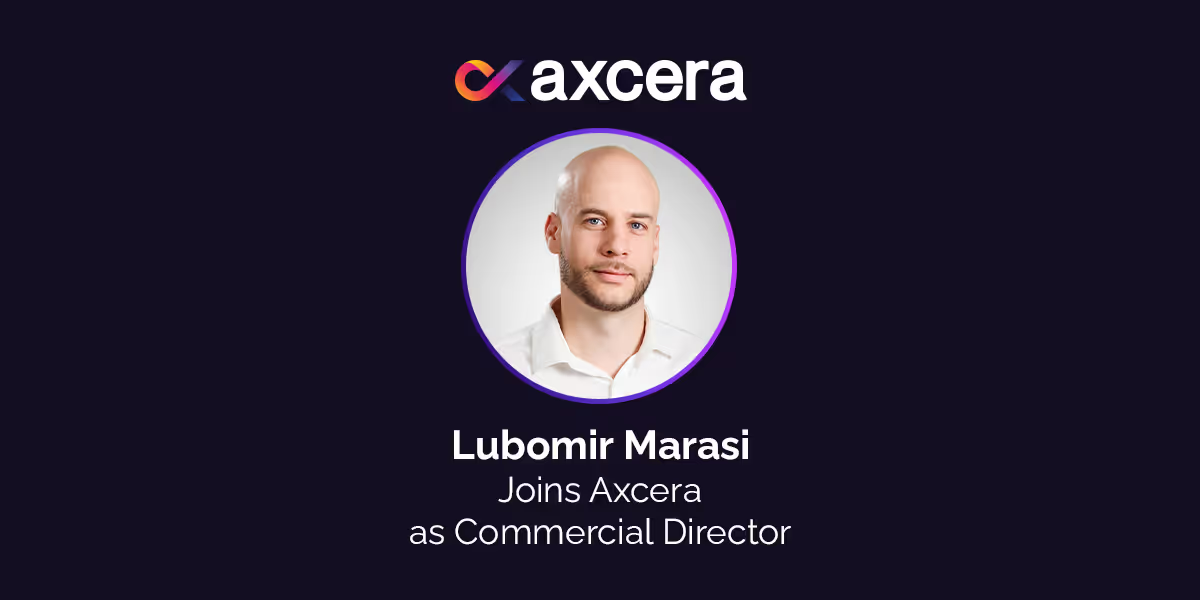
Prop Trading Expo London 2026 took place on 23 and 24 October at Old Billingsgate in London. Axcera Commercial Director Lubomir Marasi and the Axcera team attended both days, meeting prop firm founders, operators, brokers, and technology partners.
What were the main takeaways from Prop Trading Expo London 2026? Five themes came up repeatedly: more technology providers competing on price, launch costs falling while scaling costs stay high, established firms reviewing their technology providers, forex brokers needing a clearer case for dedicated prop CRMs, and relationships still driving most new business.
The common thread was operational. Founders are no longer only asking how to launch a prop firm. They are asking how to run one profitably once it is live.
Who was in the room
The audience was focused. By our team's estimate, roughly 80 to 85 percent of attendees were directly involved in the prop trading industry: firm founders and operators, brokers exploring prop models, and the providers that support them.
That meant fewer introductory conversations and more specific ones about cost, risk, payments, and technology choices.
1. More technology providers are competing for prop firms, and prices are falling
More CRM and technology vendors are entering prop trading, and many are competing on entry price. Several providers are lowering setup fees and monthly subscriptions to win new clients.
For a new firm, that is good news in the short term. It also shifts more of the evaluation work onto the buyer. A low setup fee says little about what a platform will cost once the firm is managing thousands of accounts, adding trading platforms, or processing payouts at volume.
The more useful question is total cost over time. How does pricing change as revenue grows? What has to be rebuilt when the firm adds a platform or an asset class? How much manual work does the system leave to the team? Our guide to the questions to ask any prop tech vendor before signing covers this in more detail.
2. Launching a prop firm is cheaper. Running one is not.
Technology is no longer the main barrier to launching a prop firm, but operating and scaling one remains capital-intensive. This was one of the most consistent points we heard in London.
The costs founders raised most often had little to do with software:
- Marketing budgets. Trader acquisition remains expensive, and firms are under pressure to show a return on every channel.
- Payment processing. Reliable access to payment providers and banking is still a constraint for many firms. We looked at part of this problem in our article on helping prop firms access the right banking solutions.
- Sustainable business models. Firms want challenge revenue, payouts, and acquisition costs to balance over years, not only in the first few months.
This is where infrastructure matters more than launch speed. Firms that can see the relationship between what each trader spends and what is paid out are better placed to adjust pricing, rules, and marketing spend. Axcera's Customer Lifetime Value Report, for example, compares total spend with total payouts across customers so operators can see that balance at firm level. For more on the metric itself, see why trader lifetime value will define the next generation of prop firms.
3. Established prop firms are reviewing their technology providers
A growing number of established prop firms are evaluating alternative technology providers. These conversations came mostly from firms that launched on one system and have since outgrown it.
The triggers were familiar: manual workarounds that multiply as account volume grows, difficulty adding new trading platforms, limited control over risk rules, and pricing that becomes harder to justify as the business scales. These firms are not looking for a faster launch. They want a platform they will not need to replace again in two years.
If that sounds familiar, our list of warning signs that your prop trading technology is holding you back is a practical place to start before comparing vendors.
4. Forex brokers need a clearer case for a dedicated prop CRM
Brokers adding a prop offering often start with their existing broker CRM, and that leaves operational gaps. Several conversations in London suggested that many brokers have not yet seen how different the two systems are.
A broker CRM is built around real-money client accounts, deposits, withdrawals, and introducing brokers. A prop CRM is built around a different lifecycle: evaluation purchases, rule-based account progression, breaches, resets, and payouts. Running a prop program on broker tooling usually means manual work at exactly the points where prop operations need automation.
The business case for brokers comes down to four things: operational efficiency, automation, risk management, and scalability. A purpose-built prop CRM handles the evaluation lifecycle as standard, while real-time monitoring through Risk Guard checks trading activity against each account's configured rules. On Axcera, 95% of workflows are fully automated, and firms can keep manual control wherever they prefer it.
5. Relationships still open most doors
In prop trading, personal networks, strategic partnerships, and warm introductions remain the main drivers of new business. Even with more vendors and more online marketing, many of the most promising conversations in London started with an introduction from someone both sides already trusted.
That applies to technology decisions too. Firms increasingly judge a provider by its ecosystem: which trading platforms, payment providers, and service partners it already works with. Axcera's integrations ecosystem includes 100+ integrations across trading platforms, compliance and payment providers, and automation tools.
What this means for prop firm operators
The direction after London is clear: the industry is shifting from launch to operation. For founders and operators planning 2027, four practical steps follow from what we heard:
- Price technology at your target scale, not at launch. Ask vendors what your costs look like at three and five times your current account volume.
- Map where manual work sits today. Payouts, breach reviews, and account changes are the usual places where headcount grows faster than revenue.
- Track spend against payouts per trader. It is the clearest early signal of whether the business model is sustainable.
- If you are a broker launching prop, start with a prop CRM. Retrofitting broker tooling later is usually more expensive than choosing the right system first.
Thank you, London
Thank you to everyone who met with the Axcera team at Old Billingsgate and shared their view of where the industry is heading. Many of those conversations will continue in the weeks ahead.