Axcera August 2026 Highlights: Profitable Scale Is the New Growth


The prop trading conversation is changing
For several years, growth in prop trading was largely measured by challenge sales, trader registrations and headline revenue.
Those numbers remain important, but they no longer tell the full story.
As the industry matures, the more important question is becoming: how much profitable, sustainable value does each trader create over the entire relationship with a firm?
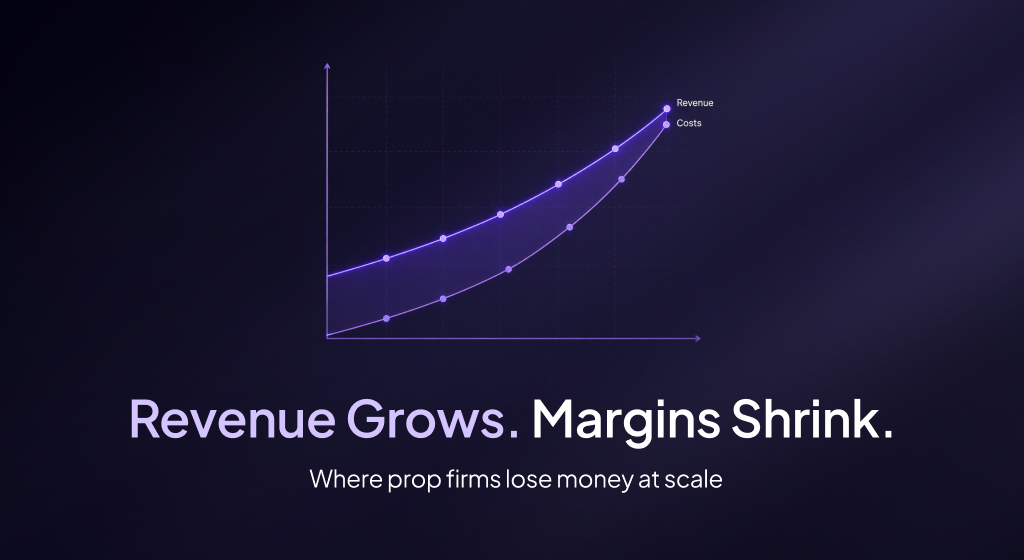
A firm can sell more challenges while its margins decline. It can acquire thousands of new traders while struggling to retain them. It can report record revenue while its support, payout, and operational costs grow even faster.
August was therefore less about announcing another collection of platform updates and more about examining what the next stage of growth will require.
The firms that succeed will not simply be those that attract the most traders. They will be the ones that understand their customers, protect their margins, and build operations capable of scaling without unnecessary complexity.
From challenge revenue to trader lifetime value
Most prop firms still measure commercial performance primarily through the revenue generated from individual challenge purchases.
That provides an immediate picture of sales, but it does not show the complete economic value of a trader.
One trader may make an initial purchase and never return. Another may purchase several challenges, buy resets or activations, progress through multiple programmes and remain engaged with the firm over a much longer period. Treating those customers as equal can lead to poor decisions around acquisition, retention and product strategy.
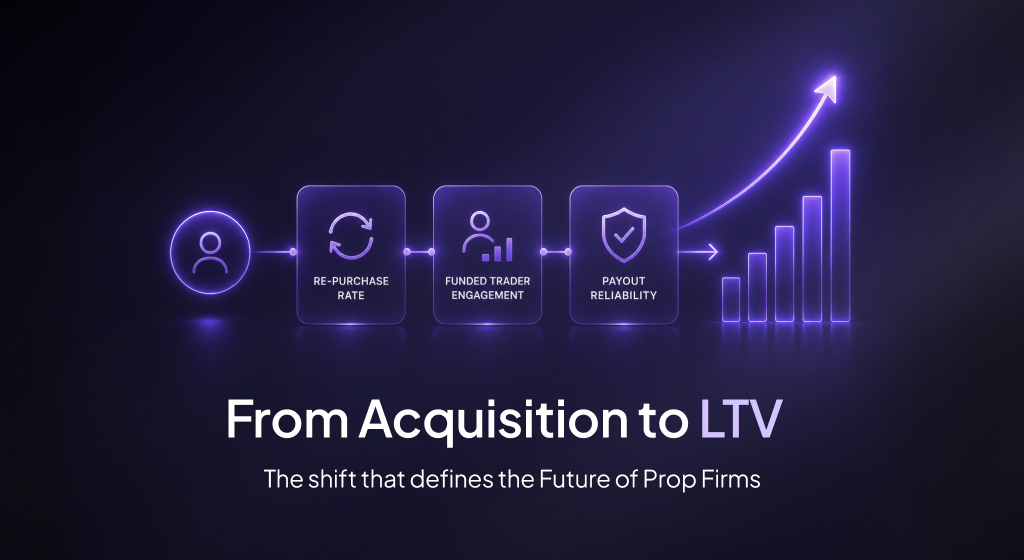
In August, we explored this shift in Trader Lifetime Value: The Metric That Will Define Prop Firms.
Trader lifetime value encourages operators to examine the complete customer relationship: how frequently traders return, how they progress, which acquisition sources produce the strongest customers and how the payout experience influences long-term trust.
A trader who already knows the brand does not need to be acquired again. A trader who has received a reliable payout has a reason to trust the firm. A customer who understands the next step in their journey is more likely to remain engaged than one who reaches the end of a programme with nowhere else to go.
Sustainable retention is not created through discounts alone. It comes from the overall experience: clear rules, consistent communication, reliable operations and relevant opportunities for traders to continue progressing.
Why growing revenue can still produce shrinking margins
The second part of the August conversation focused on what happens behind the headline revenue numbers.
In Why Margins Shrink as Prop Firms Scale, we examined a counterintuitive problem: a prop firm can grow rapidly while becoming operationally less efficient.
At a smaller scale, manual processes can appear harmless. A team member manually reviewing payouts, correcting customer records or responding individually to common questions may not initially create an obvious problem.
As volume grows, those same processes become expensive.
If doubling the number of traders requires doubling the support team, the business is not truly scaling. If every increase in payout volume produces a matching increase in manual work, growth is introducing additional cost and risk. If information is distributed across disconnected systems, teams spend more time reconciling data instead of improving the business.
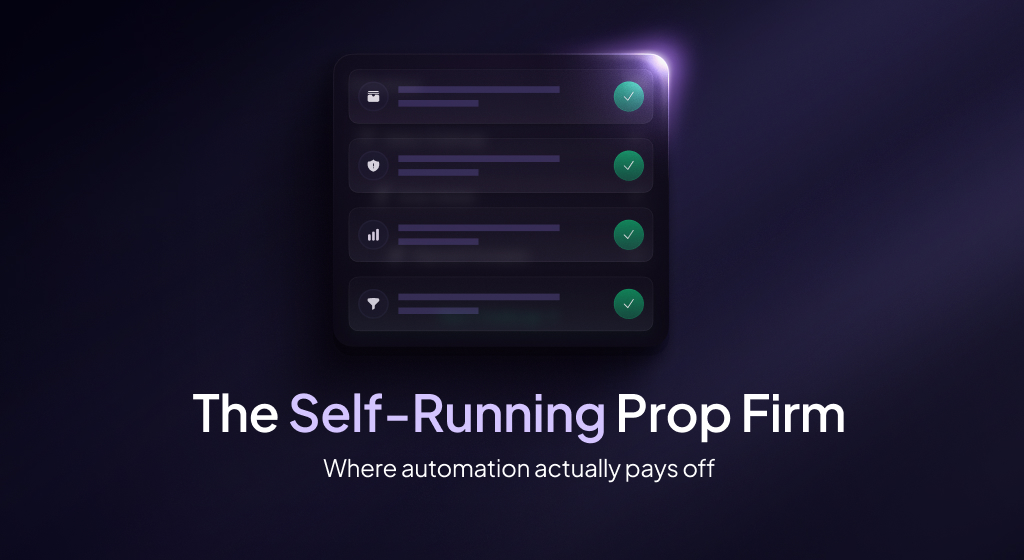
The solution is not simply to reduce costs. It is to identify which parts of the operation must become more efficient before increasing volume exposes their limitations.
How this direction appeared in August
This broader direction was reflected in several developments delivered across Axcera during August.
The new Customer Lifetime Value Report gives operators a clearer view of the relationship between customer spending and payouts. Instead of looking at isolated transactions, firms can analyse customer economics across a longer period and use that information to make better decisions around acquisition, segmentation and retention.
Axcera also expanded its Rewards System, giving firms more flexibility to encourage repeat engagement through recurring rewards, customer tiers and actions connected to resets and activations. The objective is to help operators build more structured retention programmes around meaningful customer activity rather than relying solely on one-time promotions.
Individually, these changes improve specific parts of the operation. Together, they reflect a broader objective: helping firms understand their customers more clearly, automate more of their business, and protect their margins as they scale.
Growth and infrastructure cannot be separated
Trader lifetime value and operational margin may appear to be different topics, but they are closely connected.
A firm cannot improve retention if the trader experience becomes slower or less reliable as it grows. It cannot protect its margins if every improvement to that experience creates additional manual work.
This is why infrastructure has become a commercial issue rather than merely a technical one.
However, scale requires more than automation. As prop firms become more sophisticated, they also need greater control over how their technology supports their particular operating model.
Traditional software often gives every customer a largely predefined environment. That may work initially, but it can become restrictive when a firm wants to create proprietary workflows, build its own trader interface, connect internal systems or differentiate its customer experience.
The next generation of infrastructure must provide a reliable operational foundation while giving firms more freedom to build around it.
This thinking is increasingly shaping Axcera’s direction. Alongside our configurable platform, we are working towards making more of Axcera’s underlying capabilities accessible through APIs, webhooks and modular services.
The objective is to allow licensees and their development teams to build their own interfaces, internal tools, reporting layers, integrations and automated workflows on top of Axcera’s infrastructure—without having to recreate the complex trading, risk and operational systems underneath.
Five questions every prop firm should ask
As operators plan for the next stage of growth, there are five practical questions worth considering:
- Do we know the lifetime value of traders from different acquisition channels?
- How many customers return after their first challenge or payout?
- Which operational costs increase directly alongside trader volume?
- Which important workflows still depend on repetitive manual work?
- If our trader base doubled next quarter, could our current systems and team support it efficiently?
The answers reveal more about the strength of a prop firm than headline revenue alone.
A business with strong retention, clear customer economics and scalable operations has more freedom to invest, experiment and expand. A business dependent on constant acquisition and growing headcount may find that each new stage of growth becomes more difficult than the last.
What August means for Axcera
At Axcera, our view is that the next era of prop trading will be defined by operational maturity.
Prop firms will continue to compete through branding, pricing and trading programmes, but the quality and flexibility of the infrastructure behind those offerings will increasingly determine which businesses can grow sustainably.
This is also shaping Axcera’s own evolution.
Axcera has developed as a comprehensive software provider that brings the core operations of a prop firm into one connected and configurable environment. That established technology, combined with our integrations, industry knowledge and growing licensee network, now provides the foundation for the next phase.
We are evolving from being primarily a software provider towards becoming the infrastructure platform behind modern prop firms.
This does not mean moving away from the existing Axcera platform. It means making the technology underneath it more accessible, modular and extensible.
Licensees will continue to benefit from an operating environment that works out of the box. At the same time, firms that want greater customisation will increasingly be able to use Axcera as the foundation on which they build their own technology layer.
They can retain their brand, customer relationships and operating model while creating proprietary interfaces, workflows and experiences around the core infrastructure Axcera provides.
Our role is to handle the complexity underneath: trading connectivity, data, risk, account lifecycles, automation and the systems required to operate reliably at scale. Licensees gain more freedom over how those capabilities are presented, connected and used within their businesses.
Becoming a more self-service, standardised and extensible platform is a process, and it is one on which we are placing significant focus.
The strongest prop firms of the future will not simply be larger. They will be more efficient, more deliberate about customer value and more capable of shaping their technology around their own strategy.
August reinforced that direction.
If you would like to discuss how Axcera can support the next stage of your firm’s growth, book a demo with our team.

.jpg)
.jpg)

.jpg)







.jpg)
.jpg)
.jpg)
%20(1).jpg)
.avif)