The Future of Prop Firms is Here


The prop trading industry today is largely built on the “challenge” model, thousands of aspiring traders pay fees to attempt evaluations, with only a small percentage earning funded status. This model has driven explosive growth, but it has also created a revolving door of hopefuls coming in and burning out. Looking ahead, the most successful prop firms will not be those that simply sell the most challenges; they will be the ones that retain profitable traders and build long-term partnerships. In this section, we make a bold claim: the future of prop trading is all about retention. We will examine why the current challenge-centric approach is unsustainable, what firms get by focusing on trader longevity, and how to pivot towards a retention-driven business model using smart program design and technology.
The Challenge Model: High Volume, High Churn
Prop firms have boomed by appealing to traders’ dreams of getting funded. The common pathway: pay a fee, take a challenge, and if you hit the profit target without violating rules, you get a funded account. In fact, the majority of revenue for many firms comes from these failed attempts, not from traders’ trading profits. Consider some eye-opening industry statistics:
- Pass Rates Are Extremely Low: Roughly 1 in 10 to 1 in 20 traders passes a typical evaluation. A study on prop trading outcomes found about 94% of traders fail to complete the challenge phases, with only ~6% meeting all the requirements to get funded. Another dataset showed 14% pass rate for challenges, but of all traders who start, only 7% ever receive a payout in a funded account. In other words, 93% of those who try a challenge never make a dollar of trading profit, they pay fees and walk away.
- Even “Winners” Don’t Stay Long: Perhaps the most startling insight is how few funded traders stick around. According to a TradingView survey analysis, of the small fraction who do get funded, an “overwhelming 98%” ended up severing ties with the prop firm within 6 months. In plain terms, virtually all the traders who succeed in the challenge either blow up or leave within half a year. This indicates that current prop firm models are failing to keep even their best clients engaged for the long term. Some cite emotional burnout and restrictive conditions, after achieving their goal, traders felt the environment was too stressful or limiting to continue.
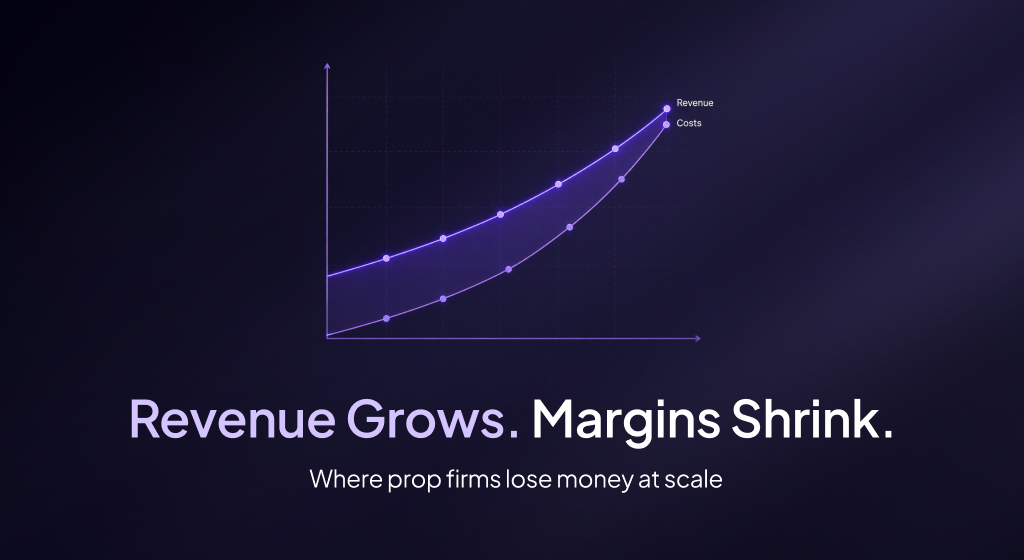
- Revolving Door Economics: Many firms have grown reliant on the churn. The average unsuccessful trader might attempt multiple challenges or account “resets.” Data suggests the typical user spends about $600 - $800 on fees across several challenge attempts. This income sustains the firm as only a handful of traders ever withdraw profits (and those profits are often small, averaging 4% of account size). In essence, firms are profiting from repeated customer failure. While lucrative in the short run, this dynamic can become a reputational risk and is fragile if market sentiment shifts or if regulations limit challenge structures.
What these figures paint is a picture of high turnover. The focus on challenges has created a model where traders are more like one-time customers than long-term clients. They pay an entry fee, and most are gone quickly, either due to failure or frustration. This churn-and-burn approach has downsides: constant marketing costs to attract fresh challengers, uneven cash flow (tied to marketing surges or popular YouTube trends), and a brand image that may suffer (“XYZ Prop makes money when you lose” is not a flattering narrative).
Why Retention is the Real Future
Imagine instead a model where prop firms derive substantial revenue from profit-splits with successful traders, meaning traders are making money and staying with the firm to generate more. In such a scenario, the firm is not just a gatekeeper selling entry tickets; it becomes a true partner invested in traders’ growth. Here is why retention-centric prop trading makes sense as the industry matures:
- Higher Lifetime Value (LTV):Acquiring a new trader via ads, affiliates, influencers, or content is expensive. If that trader joins once, takes a challenge, and leaves, the firm only earns a single fee. Retention flips the equation. Traders who stay engaged, whether by attempting new challenges, resetting accounts, or moving into higher tiers, create recurring value. What drives long-term sustainability is not whether someone passes or fails, but how many traders remain active participants over time.
- Stronger Brand and Referrals: Firms that develop a roster of genuinely successful traders gain a powerful reputation boost. Word spreads in trading communities about firms where “people actually get funded and make a living.” This positive word-of-mouth is gold. Conversely, firms known for quick failures and no payouts start to be seen as gimmicks. In the long run, as traders become more informed, they will flock to the firms where they believe they have the best chance to thrive, not just the easiest entry. Retention correlates with positive testimonials, which fuel a virtuous cycle of attracting better talent.
- Regulatory Favorability: Regulators are eyeing prop firms, partly out of concern that the challenge model resembles a lottery or gambling. A shift toward retention, which means more traders succeeding and getting paid, could alleviate some regulatory pressure. It demonstrates an alignment of interest (firm succeeds when traders succeed) rather than a potential conflict of interest. Firms that can show a reasonable percentage of traders progressing and profiting might fare better under scrutiny than those where 99% fail.
- Operational Stability: Relying heavily on constant influx of new users is risky; trends can change or a PR issue can dry up sign-ups. A base of returning, engaged traders provides a stable revenue floor. Additionally, experienced traders who stick around are easier to service (they know the rules, require less support) compared to a constant wave of newbies with repetitive questions or mistakes. Your support and infrastructure scale more smoothly when growth comes from existing users doing more, not only new users.
In essence, retention turns prop trading from a one-time transaction business into a recurring relationship business. It is akin to the difference between selling gym memberships to people who never come back versus having loyal personal training clients who renew every month.
Redesigning Programs for Retention and Trader Success
How can prop firms pivot to a retention-focused model? It requires rethinking everything from evaluation design to post-funding support. Here are strategies that foster retention:
- Make Evaluations Trader-Friendly (Without Being Easy): Many challenge rules today are unforgiving – e.g., requiring 10% profit with only 5% max drawdown, or instant failure on one slip-up. These weed out a huge portion of traders (which protects the firm) but may also eliminate potentially good traders or encourage unhealthy trading behavior (like over-leveraging to hit unrealistically high targets). For better retention, design evaluations that reflect realistic trading conditions. For example, profit targets in the single digits (5-8%) and drawdowns equal or greater than target (so traders have breathing room). Give traders enough time to demonstrate skill without feeling like they have to gamble. Firms may see more traders pass who have stable, methodical styles, exactly the kind you want to keep on board long-term.
- Implement Scaling Plans and Growth Incentives: A trader who starts with a $50,000 account might aspire to manage more capital. Top prop firms retain talent by offering account scaling – e.g., if a trader achieves X% profits in 4 months, their account size increases 25% (with proportional drawdown). By having a clear path to growing their allocation, traders have motivation to stay and keep performing. Instead of leaving to, say, trade on their own or hop to another firm for a bigger account, they can see a future with your firm (from $50k to $500k and beyond). This also benefits the firm as larger accounts from proven traders can generate larger absolute profits to split.
- Provide Education and Resources: Many traders fail challenges due to poor habits or misunderstandings. Rather than simply failing them, some firms now invest in educating their traders, even after they pay the fee. For instance, some prop firms offer personalized video lesson reviews to traders who fail, analyzing their trades and advising on improvements. This is remarkable, instead of kicking them to the curb, they help them get better for next time. Such support not only increases the chances the trader will eventually succeed, but also builds a sense of loyalty and gratitude. Retention-focused firms consider traders’ success as an ongoing project, not a pass/fail toggle.
- Foster Community and Belonging: One reason traders keep trying challenges despite failures is the burgeoning social communities around prop trading, Discord groups, Telegram, Twitter, etc., where they share experiences. A firm can tap into this by creating its own strong community for its traders. Regular webinars, forums, or meetups (virtual or in person) can create companionship. When traders feel part of a community or movement, they are more likely to stick with that firm. Some firms highlight trader achievements publicly (with permission), e.g., a monthly leaderboard or interviews with top traders. Celebrating funded traders can reinforce that this is a place where traders succeed. It shifts the narrative from “99% fail” to “look at those who win,you could be next, and we will support you.”
- Flexible Offerings (Second Chances, Extensions): Traditionally, if you fail a challenge, you are done or you pay to retry. However, new approaches show promise for retention. For example some prop firms allow traders who narrowly miss a rule (say exceeded daily loss by a hair) to buy a one-time extension instead of outright failing. This keeps traders in the game and less frustrated by technicalities. More traders remaining active in challenges means more will eventually pass and become long-term customers. It also sends a message that the firm wants you to succeed and is willing to give a bit of leeway for near-misses (while monetizing it in a fair way). Firms adopting such mechanisms could significantly improve their conversion from challenge-taker to funded trader, thus bolstering retention.
Leveraging CRM and Automation for Lifecycle Engagement
To effectively retain traders, prop firms will need to monitor and engage with them throughout their lifecycle, from first sign-up, through challenges, into funded status and beyond. This is where technology, especially Customer Relationship Management (CRM) systems and automation, plays a crucial role:
- Trader Segmentation and Behavior Tracking: A modern prop firm CRM lets you categorize traders by where they are in the journey (e.g., “Phase-1 challenge”, “Funded trader”, “On break”) and track their behavior. If you know, for example, that a trader has failed two challenges but came very close, you might tag them as “High Potential - failed” and send a tailored offer or encouragement (like a discount on the next try or an invite to a coaching session). On the other hand, a trader who just got funded should be tagged as “New Funded” and automatically entered into a retention campaign (perhaps a welcome package email, a guide on next steps, etc.). Tailored communications based on lifecycle stage ensure traders feel looked after personally, not like faceless fee payers.
- Automated Check-ins and Alerts: Automation can keep traders engaged at critical moments. For instance, if a challenge trader has not placed a trade in a week (sign of disengaging), the system could trigger a friendly check-in email: “We noticed you have been inactive, markets await whenever you are ready. Here is a market outlook to spark ideas…”. If a funded trader hits a new equity high, an automated congratulatory message reinforcing how well they are doing can boost morale. Conversely, if a funded trader hits a drawdown caution level, an automated message could offer risk management tips or remind them of available support resources. These touches, done at scale via CRM rules, help traders feel supported and guided, not left alone to sink or swim.
- Retention Offers and Loyalty Programs: Just like brokers have loyalty programs, prop firms can reward longevity. Using CRM data, you might give fee rebates to traders who have been with you for a year, or extra capital to those who have a consistent track record. For example, after 6 months of being funded, a trader could receive a coupon for a free challenge to try qualifying another account, encouraging them to deepen their engagement with your firm rather than trying a competitor. Automation can handle the issuance of these offers when milestones hit. By rewarding commitment and performance, you increase the chances traders stick around to reap those benefits.
- Full Visibility of Trader Journey: A unified platform allows management to see exactly where retention leaks occur. If you notice via analytics that a huge drop-off happens between Phase 2 pass and actual funded trading (maybe traders pass but never place a live trade out of fear or confusion), you can take action, perhaps a personal call or an orientation for new funded traders. Data might show, for instance, that traders who engage with support or community have 50% higher 6-month survival. Such insights help refine programs (maybe mandate a coaching session post-challenge as part of the package).
The difference between a firm with 5% retention and one with 20% retention could very well lie in how they utilize these tools. A centralized prop firm CRM and evaluation management software let firms track thousands of traders and apply rules uniformly, even automating phase advancements or interventions. This kind of systematization is essential for scaling retention efforts.
A Win-Win Future: Shared Success
Envision an evolved prop firm landscape: firms highlight how many of their traders have been with them 1+ year and the career progression those traders have seen. Traders choose firms not just for the initial challenge fee or payout percentage, but for the support ecosystem and growth opportunities. Those prop firms essentially function as talent incubators, identifying, funding, and nurturing trading talent for the long run. It becomes a true win-win: traders achieve their dreams of trading for a living, and firms earn steady profits from those traders’ success.
To get there, firms today must be willing to shift focus from short-term fee revenue to long-term value creation. That means possibly sacrificing the ultra-high profit margins of challenge fees in favor of investing in trader success (better technology, support, payouts). The transition can be gradual, implementing some of the retention tactics above will already differentiate a firm and likely attract a more serious caliber of trader, which starts the virtuous cycle.
In summary, retention is the future because it aligns the incentives of the business and its clients for sustained mutual gain. Prop trading started as a novel idea of letting individuals prove themselves quickly; its future is about empowering those individuals to continue succeeding and growing. Firms that recognize this shift now, and position themselves as true partners to their traders, will build brands that stand the test of time, and regulatory changes, while others fade away with the challenge hype. The age of retention is coming; those who embrace it will lead the prop trading industry into its next era.
Ready to Shift from Churn to Retention?
If you are a prop firm looking to build lasting value, start with your traders.
Let us show you how to design a retention-first model.
Contact us for a free strategy consultation or demo of retention-ready trading tech.
The future is retention. Let’s build it together.

.jpg)
.jpg)

.jpg)










.jpg)
.jpg)

.jpg)

%20(1).jpg)
.avif)