The Scalability Crisis Facing Prop Trading Firms


Why most prop firms hit growth walls at 1,000 traders and how modern infrastructure enables true mass scalability.
The prop trading industry has a scalability problem. Most firms start with manual processes that work fine for a few hundred traders. But when growth accelerates, these same processes become operational nightmares that kill momentum and destroy trader experience.
We have seen firms go from 500 to 10,000 monthly traders in six months, then collapse under operational weight. Others plateau at 1,200 traders because their systems cannot handle more volume. A few breakthrough to massive scale by building infrastructure that grows with demand.
The difference between firms that scale successfully and those that hit walls comes down to one factor: infrastructure architecture decisions made early in the growth curve.
The Growth Wall Every Firm Hits
Most prop firms follow the same trajectory:
Phase 1 (0-500 traders): Manual processes work. Small team handles onboarding, rule enforcement, and payouts personally. Growth feels manageable.
Phase 2 (500-1,500 traders): Cracks appear. Manual onboarding creates delays. Rule violations require constant monitoring. Support tickets multiply. Team works longer hours but efficiency drops.
Phase 3 (1,500+ traders): Crisis hits. Systems crash during peak periods. Traders wait days for account access. Manual processes break down completely. Growth becomes impossible without dramatic infrastructure changes.
Most firms never escape Phase 2. They hire more staff to handle manual processes, which increases costs but does not solve systemic scalability issues.
What Mass Scalability Actually Requires
Firms that breakthrough to massive scale share common infrastructure characteristics:
Automated Account Lifecycle Management
Manual onboarding, rule enforcement, and account maintenance kill scalability. At 1,000+ traders, human processing creates unacceptable delays and error rates.
Scalable firms automate account creation, credential delivery, risk monitoring, and violation processing. Traders get immediate access while compliance runs automatically in the background.
Real-Time Risk and Performance Monitoring
Manual risk monitoring becomes impossible at scale. Traders need instant feedback on drawdown limits, profit targets, and rule violations.
This requires real-time data processing systems that monitor thousands of accounts simultaneously and enforce rules without human intervention.
Infrastructure That Handles Volume Spikes
Marketing campaigns and viral growth create massive application spikes. A successful campaign might bring 2,000 applications in 24 hours.
Legacy systems crash under these loads. Scalable infrastructure handles volume spikes without performance degradation or manual intervention.
Automated Compliance and Reporting
KYC processing, payout calculations, and regulatory reporting must run automatically at scale. Manual compliance processes create bottlenecks that stop growth and create regulatory risks.
The 20,000 Trader Case Study
One firm we know experienced explosive growth that tested every assumption about prop firm scalability. Their trajectory illustrates both the opportunities and challenges of mass scale.
The Starting Point: 400 monthly active traders with mostly manual operations. Small team handled everything personally with basic tools and spreadsheets.
The Growth Surge: Marketing effectiveness suddenly improved. Applications jumped from 100 per week to 500+ per week. Within four months, they had 8,000 active traders.
The Infrastructure Crisis: Manual processes collapsed. Traders waited 3-5 days for account access. Rule violations went undetected. Support tickets overwhelmed the team. Growth stalled despite continued marketing success.
The Infrastructure Response: Complete operational automation deployment. Automated onboarding reduced account delivery time from days to minutes. Real-time risk monitoring handled rule enforcement automatically. Automated compliance systems processed KYC and payouts at scale.
The Results: Growth resumed immediately. Within 12 months, they reached 20,000 monthly active traders with the same core team size. Operational costs per trader dropped 60% despite 50x growth in trader volume.
The key insight: infrastructure automation enabled growth that manual processes made impossible.
Why Traditional Systems Fail at Scale
Most prop firm platforms were designed for small operations and break down predictably at scale:
Database architecture: Single-server databases crash when thousands of concurrent users access accounts simultaneously.
Manual workflow dependency: Systems requiring human approval or processing create bottlenecks that stop growth.
Monolithic design: Tightly coupled systems cannot scale individual components based on demand.
Real-time processing gaps: Batch processing systems cannot provide instant feedback required for trader engagement.
Integration limitations: Legacy platforms cannot connect to multiple brokers, payment processors, and compliance tools simultaneously.
These limitations are not fixable through optimization. They require fundamental architecture changes.
Infrastructure Components for Mass Scalability
Truly scalable prop firm infrastructure requires specific technical capabilities:
Distributed Data Architecture
Account data, trading history, and performance metrics must be distributed across multiple systems to handle concurrent access by thousands of traders.
Event-Driven Processing
Account updates, rule violations, and performance milestones must trigger automated responses without human intervention or batch processing delays.
API-First Integration
All systems must communicate through APIs to enable real-time data flow between trading platforms, risk systems, and compliance tools.
Horizontal Scaling Capability
Infrastructure must add capacity automatically during peak demand and scale down during quiet periods.
Real-Time Analytics
Performance tracking, risk monitoring, and business intelligence must update instantly as trading activity occurs.
The Economics of Scalable Infrastructure
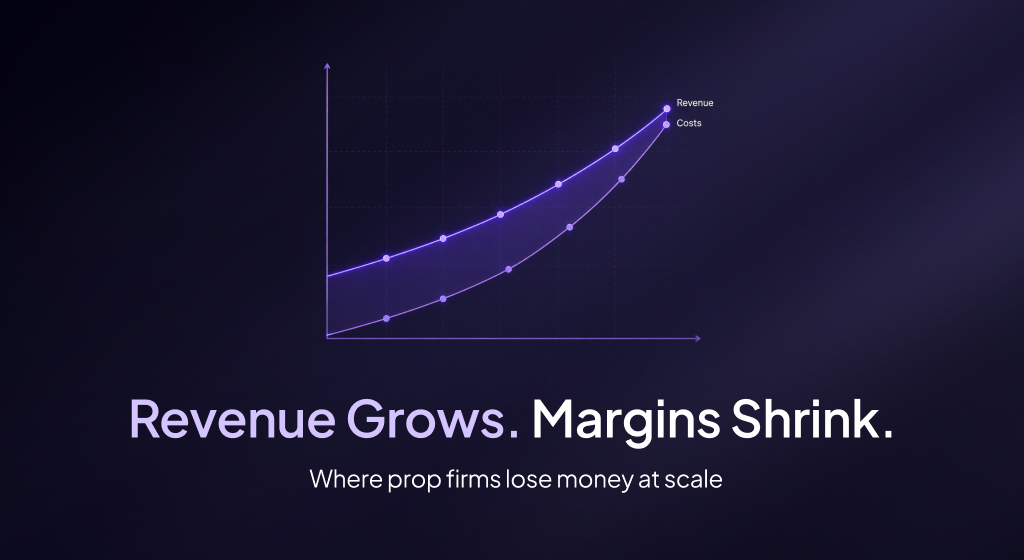
Infrastructure investment seems expensive until you calculate the economics of manual operations at scale:
Manual processing costs: At 10,000 traders, manual onboarding requires 15+ full-time staff. Automated systems handle the same volume with 2 people.
Error rates: Manual processes create 5-10% error rates in account setup and compliance. Automated systems achieve 99.9%+ accuracy.
Response times: Manual systems take hours or days to process routine requests. Automated systems respond in seconds.
Opportunity costs: Manual bottlenecks prevent marketing scalability. You cannot run aggressive campaigns if your systems cannot handle the volume.
The infrastructure investment pays for itself within months at scale.
Market Timing and Competitive Dynamics
The prop trading market is consolidating around firms that can scale effectively. Firms stuck with manual processes lose market share to those with automated operations.
This creates a bifurcation: a few large firms with scalable infrastructure capture most growth while smaller firms struggle with operational limitations.
Early infrastructure investment creates sustainable competitive advantages that compound over time. Firms that delay automation face increasingly expensive catch-up investments.
Implementation Strategy for Scalable Growth
Firms planning for mass scalability should prioritize infrastructure development before hitting growth walls:
Assess current limitations: Identify manual processes that will break first under increased volume.
Design for 10x scale: Build infrastructure that can handle 10x your current volume without architectural changes.
Automate critical paths: Focus first on account onboarding, risk monitoring, and compliance processing.
Plan for volume spikes: Ensure systems can handle sudden traffic increases from successful marketing campaigns.
Implement monitoring: Deploy systems that alert you to performance issues before traders notice problems.
Starting these investments early prevents the crisis-driven scrambling that stops growth momentum.
The Future Belongs to Scalable Firms
The prop trading industry rewards firms that can grow efficiently while maintaining quality. Manual operations create natural growth limits that prevent firms from capturing market opportunities.
Infrastructure automation is not just about operational efficiency. It is about building sustainable competitive advantages in a market where scale creates winner-take-all dynamics.
Firms that invest in scalable infrastructure now will dominate market share as the industry continues consolidating. Those that stick with manual processes will find themselves unable to compete on cost, quality, or growth speed.
Building for Tomorrow’s Scale
Most prop firms underestimate their scalability requirements. A successful marketing campaign can triple your trader volume overnight. Viral growth can bring 10,000 applications in a week.
Infrastructure decisions made today determine whether you can capitalize on these opportunities or watch them turn into operational disasters.
The firms winning at mass scale all made the same choice: they invested in automation and scalable architecture before they absolutely needed it. By the time infrastructure becomes a crisis, it is too late to build it properly.
The question is not whether you will need scalable infrastructure. The question is whether you will build it before your competition does.
Preparing for Mass Scalability
Building truly scalable infrastructure requires specialized expertise in high-volume trading operations, automated compliance systems, and distributed architecture design.
Axcera provides the technical foundation that enables mass scalability: automated account management, real-time risk monitoring, distributed data architecture, and API-first integration systems.
Ready to build infrastructure for mass scalability?
Contact Axcera to discuss the technical requirements for handling 10,000+ active traders. We help prop firms build the foundation for unlimited growth.

.jpg)
.jpg)

.jpg)








.jpg)
.jpg)

.jpg)


%20(1).jpg)
.avif)