When to Hire vs When to Automate in a Prop Trading Firm


Growing prop trading firms face a recurring question every quarter: Should we hire another person, or should we automate the workflow? Getting the answer right separates firms that scale cleanly from firms that grow expensively.
The answer depends on the nature of the task.
Hire when the task requires judgment
Judgement-based work benefits from a person who understands context. Partnership development, product strategy, complex dispute resolution, and market positioning all involve nuance that systems cannot replicate. A skilled hire in these roles compounds value over time, because each decision improves the next one. Hiring here is an investment, not a cost.
Automate when the task is repetitive and rule-based
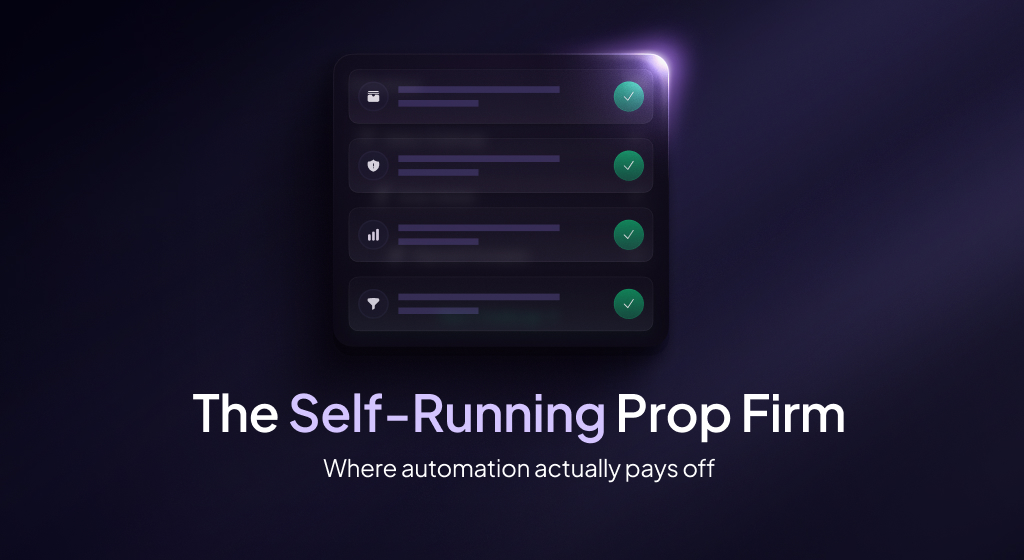
Five workflows account for most of the operational load inside a prop trading firm. Each one follows predictable logic and benefits significantly from automation.
Payout processing. Approvals based on challenge rules, payout caps, and account state. At low volume, a single operator handles this. At higher volume, manual approvals become a bottleneck that delays traders and increases dispute risk.
KYC and onboarding verification. Document checks, sanctions screening, and digital agreements. Doing this manually creates queues that traders experience as friction, which translates directly into drop-off between purchase and first trade.
Challenge rule enforcement. Drawdown limits, daily loss thresholds, and restricted instrument rules. Enforcing these manually means breaches are detected hours after they occur, by which point the exposure has grown.
Account state transitions. Moving accounts from evaluation to funded, from active to breached, from funded to scaled. Each transition triggers downstream actions that need to happen consistently. Manual handling introduces gaps that compound across thousands of accounts.
Trader communications. Status updates, payout confirmations, rule reminders, and milestone messages. When these are sent manually, they get sent inconsistently, which damages trader trust over time.
In each of these areas, the work is identical from one trader to the next 80 to 90 percent of the time. That is the signature of work that should be automated, not staffed.
The mistake most prop trading firms make
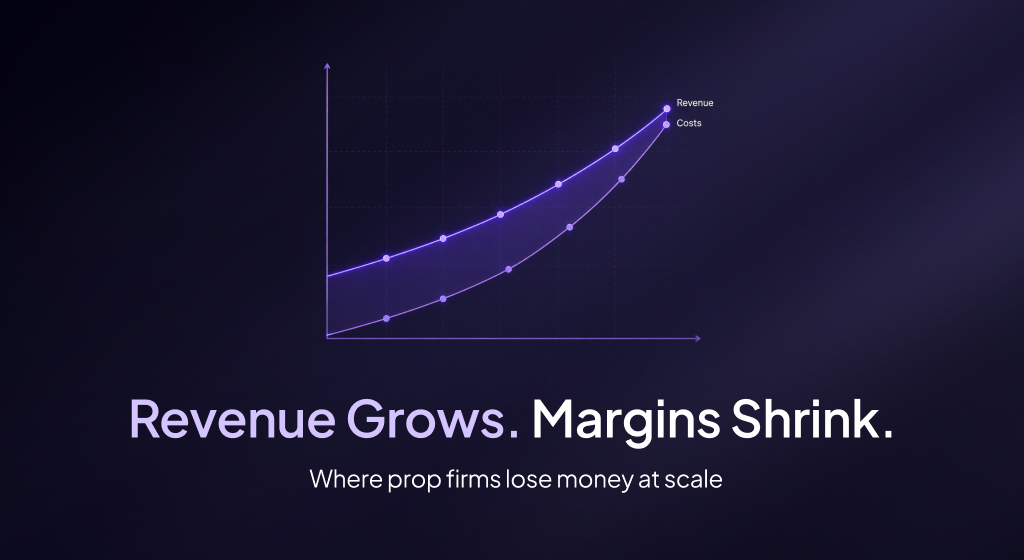
Hiring for tasks that should be automated. The result is a growing team that is busy but not productive, executing the same manual steps at increasing volume while the cost base rises with every new hire. The most common pattern we see across firms: every 500 new traders requires a new operations hire. That is not scaling. That is linear growth dressed up as success.
The deeper cost is the one most operators miss. Manual work introduces inconsistency. Two operators handling the same payout flow will make slightly different decisions. Two support agents handling the same KYC issue will close it on slightly different timelines. Over thousands of repetitions, these small variations create the operational drag that explains why margins shrink as firms grow.
A useful test
If a task follows the same decision tree more than 80 percent of the time, it should be automated. If it requires a different approach every time, it needs a person.
Apply the test to every recurring task in the business. It is not perfect, but it is directionally right far more often than not, and it forces operators to stop defending manual work that should have been replaced.
The deeper point
Automation does not replace people. It frees them. The team you hire after automating well is smaller, more senior, and more focused on the work that actually moves the business forward. Support agents stop answering "where is my payout" tickets and start resolving complex disputes. Operations leads stop reconciling spreadsheets and start improving processes. Finance teams stop processing every approval and start spotting risk patterns.
That is what scalability looks like in practice. Fewer manual steps, sharper judgment at the top, and a platform that handles the repetitive work consistently. The prop trading firms that get this balance right compound their position over time. The firms that hire instead of automate keep paying for growth they should have engineered.
Closing thought
If you are evaluating which workflows to automate next, the conversation usually starts with a clear view of what your platform can already handle. We are happy to walk through that with you. Schedule a conversation with the Axcera team: https://axcera.io/book-a-demo

.jpg)
.jpg)

.jpg)








.jpg)
.jpg)

.jpg)

%20(1).jpg)
.avif)