Perps in Prop Trading: The Commercial Case, and What It Costs to Operate

The arguments for adding perpetual futures to a prop firm are good ones. That is precisely the problem. They are good enough that the question usually stops there, and the question that decides whether this works is the one after it.
Perps are not a harder instrument to offer than forex. They are a harder instrument to operate around, and the difference shows up in a part of the business most firms do not model when they are deciding: their own working week.
Key takeaways
- Perps could take real share from CFD-based prop trading: they run around the clock, leverage and margin are configurable, and position sizes can be smaller.
- The commercial case is real: no expiry, no rollover, settlement that does not depend on regional banking, and an audience that already trades the instrument elsewhere.
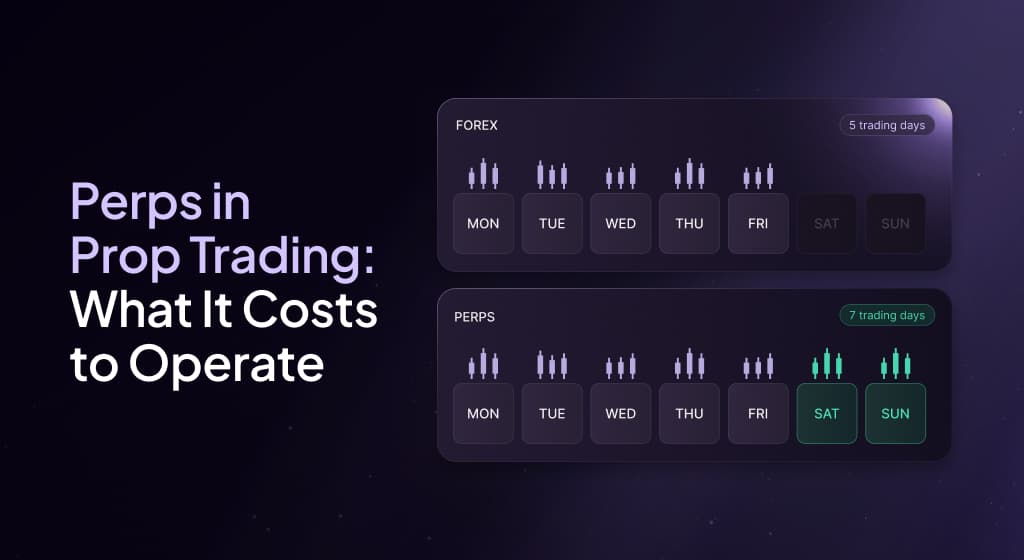
- A perpetual market runs 168 hours a week. Forex runs about 120. The 48-hour difference is the weekend, and your team does not work it.
- The cost does not disappear, it moves. Fees and market data can fall, while risk review, payout approval and escalations now need covering on Saturday and Sunday.
- Staffing every weekend is expensive and mostly idle. The alternative is a system that keeps watch while your team is off.
Why perps could reshape prop trading
Perpetual futures could take a significant share of the market from CFD-based prop firms. The draw is greater transparency, potentially lower operating costs and access to decentralized order books.
Traditional futures are not going anywhere. But platform fees, market data costs, regulatory requirements and shrinking margins are pushing firms to look at alternatives.
Perps offer a different proposition: trading around the clock, flexible leverage, cross and isolated margin, and smaller position sizes. That gives a prop firm more room to design competitive trading programs.
At the same time, decentralized exchanges are gaining ground, and their growing trading activity is a direct challenge to the centralized model.
For a prop firm, that is a chance to rethink its cost structure, reach new traders and compete in a market that gets more demanding every year.
Why the commercial case for perps is sound
For a single firm, taken one at a time, the reasons hold up.
No expiry means no rollover. A futures contract dies on a schedule, and every firm offering them carries the operational weight of that: rolling positions, explaining the roll to traders, handling the accounts that got caught in it. Perps have no expiry date at all. The instrument simply continues, which removes a recurring event from your calendar and a recurring category from your support queue.
Settlement stops depending on where your trader lives. Paying a trader in one country is a solved problem. Paying traders in forty is a procession of regional banking relationships, each with its own onboarding, its own failure modes and its own week-long delays. Perps settle in stablecoins, which collapses that into one rail that behaves the same everywhere.
The audience already exists and is not currently buying from you. Crypto-native traders are numerous, comfortable with leverage, and accustomed to self-service products. Most of them have never bought an evaluation. They are not a segment you have to convert from a competitor, which is unusual in this industry and worth something.
More hours per account. This is the one every deck leads with, and it is true. It is also the thing that costs you, which is the rest of this article.
The trading hours are the whole story
Here is the number the commercial case rests on, and the same number the operating case rests on.
The forex week runs from around 22:00 UTC on Sunday to 22:00 UTC on Friday. Call it 120 hours. Most of the popular exchange-traded futures run 23 hours a day across five days, with a daily break for settlement and maintenance, so roughly 115 (CME Globex trading hours).
A perpetual market runs 168.
That is 40% more market than forex and closer to 46% more than futures. Put another way, the difference is exactly 48 hours, and those 48 hours are Saturday and Sunday. Perps add the weekend, and the weekend is when your team is off.
This is not a crypto-only argument any more, incidentally. One of the world’s largest derivatives exchanges now runs its crypto contracts around the clock, seven days a week. The industry’s reference point for what a trading week looks like has already moved.
Two consequences follow, one for your traders and one for your team.
The first is about your traders. Forty-eight more hours a week cut both ways. A trader gets more time to reach the target and pass, and the same extra time to hit a limit and fail. Whether that works in your favor depends on whether the program’s rules were built for a seven-day week. A time limit counted in calendar days, for example, gives a forex trader about 21 trading days out of 30. It gives a perps trader all 30. Either way, accounts resolve faster, which changes your cash flow timing.
The second is about your team. Most prop firms run their operations Monday to Friday. With forex, that matched the market: it stopped on Friday evening as well, so nothing new happened while the team was off. With perps, two full days of trading happen every week with nobody from the team there.
What waits until Monday: risk, payouts and escalations
Walk through what your team does Monday to Friday, and ask what happens to it on Saturday and Sunday.
Risk review. Someone on your team checks unusual accounts and trading behavior during the week. From Friday evening to Monday morning, a perps market keeps running and nobody is looking. Anything that would have been caught on a Tuesday now has two days to grow.
Payout requests. A trader can hit their target on Saturday and request a payout the same day. Some firms approve smaller payouts automatically, under a set amount, so those go through. A larger request waits for whoever approves payouts, and if that person works Monday to Friday, it sits pending all weekend. On a perps program the trader spends that weekend trading and checking on a payout nobody is looking at. That is how a routine request turns into a support ticket, and sometimes into a public post.
Escalations. Round-the-clock support is normal now, though some firms still do not offer it. What usually is not covered is escalation: the issues a support agent cannot solve alone and has to pass to someone in risk, payouts or operations. That someone works Monday to Friday. Crypto-native traders are the least likely to accept waiting until Monday, because the exchanges they came from never close.
None of these needs a new rule. Each one needs someone, or something, to be there on a Saturday.
You cannot hire your way to 168 hours
The obvious answer is coverage: a weekend rota, or a second team that works Saturday and Sunday.
Think it through before committing to it. Covering two extra days means either asking your team to work weekends, or hiring people whose job is mostly waiting. Either way you are paying for availability, not for work. Most weekends are quiet, so most of what you are buying sits idle, until the weekend that is not. For a firm of any size below the very largest, this is not a sensible place to put headcount.
This is where the lower operating cost from the start of this article either holds or quietly disappears. A firm can save on platform fees and market data, then spend the saving, and more, on people paid to be on call every Sunday. The cost has not gone away. It has moved.
The alternative is not to leave it uncovered. It is to change what requires a person.
Most of what a team would do on a weekend is not judgment. It is noticing. Somebody checks whether a payout request arrived. Somebody looks at whether an account is approaching a threshold. Somebody scans for the unusual. All of that is detection, and detection is the part a system does better than a rota, because a system is already awake.
What is left after detection is the small set of cases that need a human decision, such as a payout above the amount a firm approves automatically. Those can wait until Monday, as long as the trader is not left guessing. The system can confirm the request straight away and say when it will be reviewed. The goal is not to automate the decision. It is to make sure the decision is already prepared, with its context attached, when somebody arrives on Monday to make it.
That is the same argument as making a growing firm stop hunting for its own work, and perps make it urgent rather than merely sensible. A five-day instrument lets a firm get away with manual detection. A seven-day one does not.
What to settle before you launch perps
If perps are on your roadmap, these are worth having answers to before anything goes live, because each one is cheap now and expensive later.
- Which of your rules assume a day that ends, and what time do they reset at when the market does not?
- Who is notified when something material happens over the weekend, and what are they expected to do about it?
- Who handles an escalation on a Sunday, when support cannot solve it alone?
- Which decisions genuinely need a person, and which are being done by a person only because nobody has asked the question?
- What happens to a large payout requested on a Saturday?
None of these are perps questions, strictly. They are questions every firm should be able to answer already. A continuous market is simply the thing that stops letting you avoid them.
The decision underneath the decision
The commercial case for perps holds up. No expiry, one settlement rail, a trader population that is already there, and more hours in which your product is usable.
What that case leaves out is that the same hours are hours of exposure, and exposure has historically been supervised by people working a schedule the market agreed to. Perps do not agree to it.
So the real question is not whether perps are good for your firm. It is whether your operation runs on a weekend shift or on a system that does not need one. Firms that answer that before launching will find perps a straightforwardly good addition. Firms that answer it afterwards will discover the answer during their first bad weekend.
What is next: perpetual futures at Axcera
At Axcera, we are taking this a step further. We are building our own perpetual futures platform, which will be available to every Axcera customer, so prop firms can expand into crypto perpetual markets through the Axcera ecosystem.
Our vision goes beyond adding another trading instrument. We are bringing perpetual futures together with the risk management, automated workflows, payout infrastructure and operational capabilities prop firms already rely on, including the part this article is about: a system that keeps watching when nobody else is.
We will share more about our perpetual futures offering as development progresses.
The future of prop trading is continuous, and we are building the infrastructure to support it.